01
Start with your questions
Prices, timing, streets, property taxes: every West University question gets a direct answer grounded in current data, not a sales pitch.
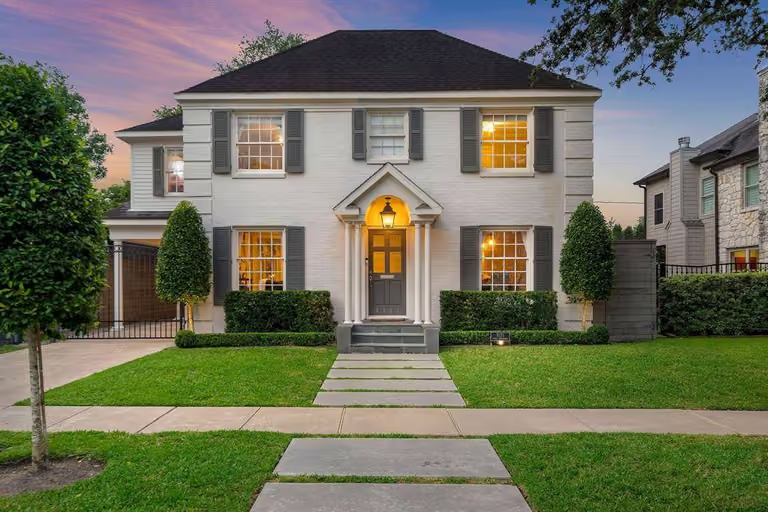
At home in West University.
Neighborhood answers, current market data, and a clear next step, whether you're buying in West University or thinking about selling. From Paige Martin of the Houston Properties Team at Real Broker, LLC.
New to the area? Start with the West University neighborhood guide.
By the numbers
West University market data as of October 2026.
These figures in context: see the full West University market update.
Questions & answers
Start with the parcel rather than the listing: West University Place writes its own zoning ordinance, the city adopts its own tax rate, school zoning is confirmed per address, and floodplain status is a parcel question. Then settle financing early, because with 204 sales a year the right house appears only a few times a year.
The order of operations matters because the rules are the city's own: what can be built or rebuilt on a 5,000-square-foot lot, which campus an address is zoned to and what the city rate adds to the tax bill are all decided locally rather than by Houston. Flood due diligence runs in parallel: the mapping tool first, the FEMA map to confirm. Once those questions have answers, the search itself is about patience and preparation in a market with 4.3 months of inventory. The West University neighborhood guide covers each step in detail.
Homes across West University sold around a $1,899,513 median at an average of $544 per square foot as of October 2026, with 38 median days on market. The range is wide: the same market holds original cottages selling near land value and new construction far above the median.
Those are city-wide figures, and the 26 subdivisions differ in typical lots, ages and price points, so treat the number as a frame rather than a valuation. Supply matters as much as price: 4.3 months of inventory and a 99.4 percent sale-to-list ratio describe a market where accurately priced homes close near asking while overpriced ones sit. The full band of figures, what each one measures and what it cannot tell you sit on the West University market update.
The figures as of October 2026 answer different halves of the question: a 99.4 percent sale-to-list ratio says what closings ran against asking, while 38 median days on market and 4.3 months of inventory say how long a sale takes and how much choice buyers have. Whether it is a good time for you depends on your next step.
In a market with more supply, pricing it right the first time matters more than timing the season: the sale-to-list ratio is measured against final list price, and reductions give back more than patience gains. An owner who must buy again locally faces the same figures from the other side, which is why the decision starts with numbers for your own home rather than the area's. Before choosing a list date, get the data side settled with a home valuation grounded in closed sales from your own section of the city.
Southside Place suits buyers who want an independent small city between West University Place, Bellaire and Houston: about 1,835 residents on 0.25 square miles as of the 2020 census, with its own 24-hour police department, a volunteer fire department, and a park and pool at the center of the neighborhood.
The city opened on Easter Day in 1925, developed by Edlo L. Crain on land that previously housed the Harris County Poor Farm, and it incorporated in June 1931. Crain placed a pool and a park in the subdivision from the start, and the park and pool facilities are operated by the Southside Place Park Association today, with Fire Truck Park a local landmark. The Southside Place Police Department fields 12 sworn Texas Peace Officers, and the volunteer fire department holds mutual aid agreements with West University Place and Bellaire. For tax year 2025 the city adopted a rate of 0.3408960 per $100 of taxable value. Bellaire Boulevard is the primary business corridor, and Houston ISD splits the city at two of the three levels, elementary between West University and Twain and high school between Lamar and Bellaire, with Pershing Middle School over the whole city. The city's own market figures, tax rate and flood checks sit on the full Southside Place profile.
Ask any candidate for their West University closings by address from the past 24 months, then check the claims: closed transactions are a matter of public record in Harris County, and a specific answer that cites addresses is worth more than any market-wide statistic an agent can recite.
Volume is only the start; ask where the closings sat, in which of the 26 subdivisions, and what the agent checked before each offer: the city's zoning requirements, school zoning for the exact address, and the parcel's floodplain status. Ask for the last three list-to-close price ratios and references from both a buyer and a seller. An agent working West University should also explain how the market's pace changes strategy, because 204 sales a year and 4.3 months of inventory reward preparation over speed. A fuller set of hiring questions, with Paige Martin's own record, sits in the West University agent-selection guide.
One subject at a time
In October 2026, a Texas house with several heirs sells once title is settled: by probating a will, sometimes as a muniment of title, by letters testamentary to an executor, or by a court's heirship determination where there is no will.
Neither spouse may sell or encumber a Texas homestead without the other's joinder, and on a disappearance or abandonment ground the petitioning spouse may file to sell alone no earlier than the 60th day after it (read September 2026).
The 10 percent appraisal cap does not apply to a house until January 1 of the tax year after its owner first qualifies it, so where the house carried a cap for years the taxes may rise substantially the year after a purchase (read September 2026).
What the multiple listing service's status codes mean for a West University Place listing that came off the market, and what gets looked at again before the house goes back on.
In September 2026, Texas heirs can divide a house by family settlement agreement only if all agree and no beneficiary is under 18; otherwise, county-court partition needs administration.
What to ask a West University agent about the price and the listing agreement, with each rule traced to the document that states it and to the condition that document attaches.
How this site works for you
01
Prices, timing, streets, property taxes: every West University question gets a direct answer grounded in current data, not a sales pitch.
02
Neighborhood-level numbers, refreshed as the market moves, so a decision to buy or sell in West University rests on data rather than headlines.
03
Paige Martin works in West University specifically and follows it closely, with the details that only come from being local.
Your next step
Ask for a valuation grounded in current West University sales, or call Paige's team at (713) 425-4194 to talk through a purchase or a sale.